Giovanni Battista Piranesi, who lived in Italy from 1720 to 1778, is an actor who deeply influenced 18th-century architecture and beyond, considered by Tafuri as the inception of the avant-garde, far beyond being an architect and engraving artist. Despite having a few constructed buildings throughout his life, Piranesi has been the unwanted persona of his own era and the inspiration source for hundreds of years to come through his discourses and engravings. Piranesi brings contradictions together. As read from the sentence in plate IX of Piranesi's Parere su l'architettura (Thoughts on Architecture, 1765) — "They belittle my novelty, I belittle their cowardice" — his positioning of novelty (freedom, art) / cowardice (dependency, craft, copying) is clearly observed. Piranesi intermittently produced 16 plates in the Carceri engraving series between 1745 and 1761. The engravings featuring never-ending grand structures, crushing masses, stairs leading nowhere, bridges not converging, chains, and torture instruments caused a great stir in their era and have been widely debated.
Tafuri's naming Piranesi as the forerunner of the avant-garde movement is transparently interpreted through these engravings. In his engravings, Piranesi rejected the conventional design understanding and forms of the era, portraying imaginary spaces based on imagination and personal psychology. In his self-built imaginary prison, he sought ways to create a new architectural composition and to "reconstruct architecture." Tafuri views the new architectural composition language that Piranesi built as the execution of a "critical act," describing this active transformation as "a process of demolition, dissolution, and non-conformity." Tafuri, with the strategy of "active transformation," describes a method that first decomposes the architectural object into particles and then reassembles it in a different composition and interprets this through Piranesi's engravings. The fragmented architectural elements take a new position, becoming autonomous from their context and object, and are reassembled with a different strategy. This "fragmentation" also parallels Russian director Eisenstein's concept of "montage."
Throughout the studio period, the visionary's concept of time was also deconstructed in readings beginning with Bürger. The differences between the imaginative and predictive clearly expose the formation of the visionary and the relationship between visionariness and time. Future imaginations built over the existing time can be classified as "predictive". The imagination that we can define as imaginative fiction can be defined as scenarios that are independent of their time and can jump between times. Imaginations that can liberate themselves from their daily conditions and time will be defined as "visionary" within the scope of this research and will determine the position of the research.
Tafuri suggests that in architecture, the avant-garde is possible through detaching from its time. Tafuri, stating that the avant-garde emerges in times of crisis and is nourished by criticism, underlines the relationship between timelessness and the avant-garde. Piranesi's Carceri engraving series can be considered primary example of imaginary fiction. In the subsequent sections of the research, speculations about 21st-century Istanbul will be produced, based on the approach of Piranesi, who produced without being bound by the conditions in which he existed but without rejecting the past. Considering that Piranesi worked in an archaeological excavation of the ancient city in Rome and was influenced by these remnants in the Carceri series; the scenario of Piranesi living in Istanbul in 2018 and working at the Yenikapi Archaeological Excavation site does not seem like a far-fetched possibility.
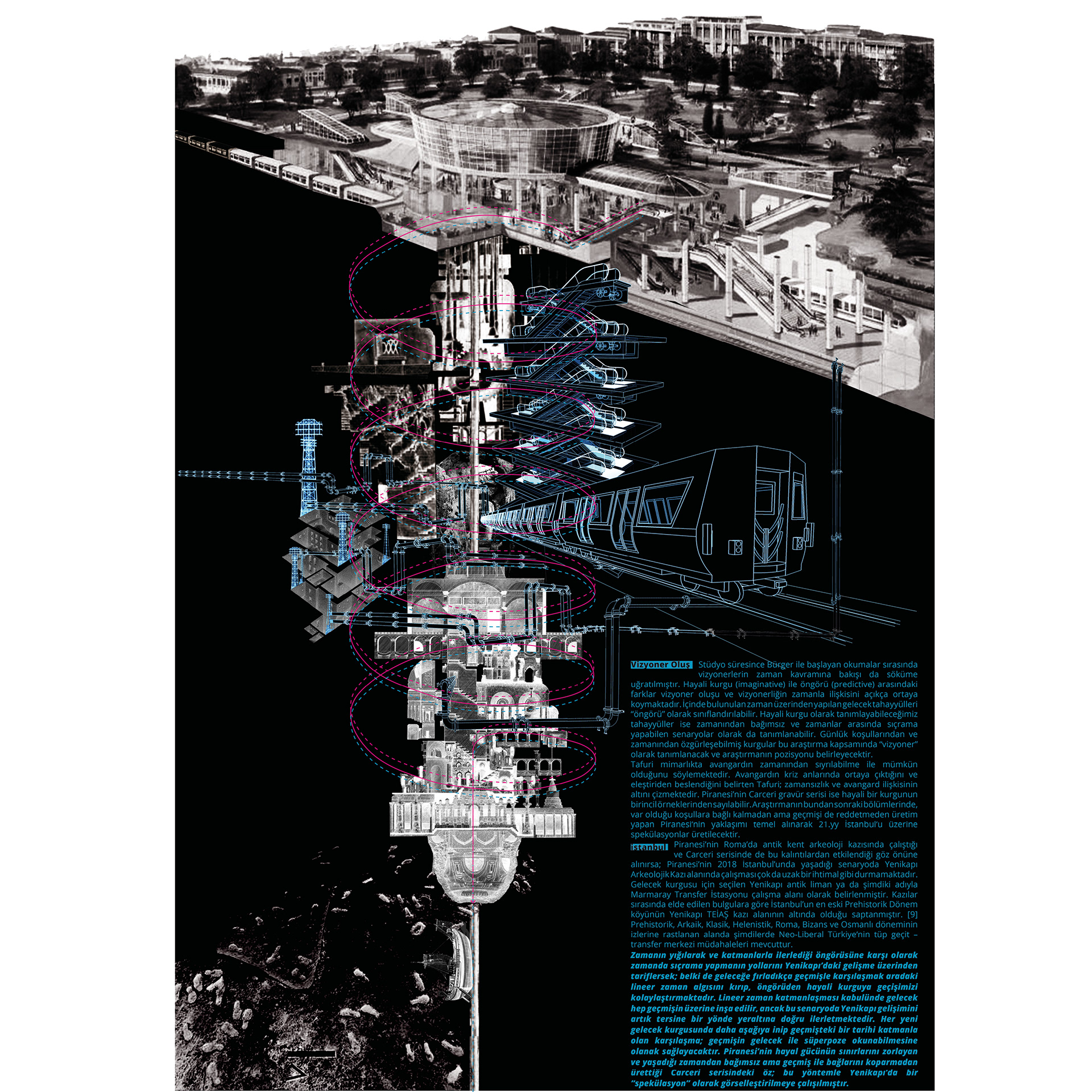
The Yenikapi ancient port, or now called Marmaray Transfer Station, was chosen as the study area for the future scenario. According to the findings obtained during the excavations, it was determined that the oldest Prehistoric Period village of Istanbul was under the Yenikapi TEIAS excavation area. The area, where traces from the Prehistoric, Archaic, Classical, Hellenistic, Roman, Byzantine, and Ottoman periods were found, now has the interventions of Neo-Liberal Turkey's tube passage - transfer center.
Against the anticipation that time progresses cumulatively and in layers, if we describe the ways to leap in time through the development in Yenikapi; perhaps as we catapult into the future, encountering the past might shatter the linear perception of time in between, easing our transition from predictive to imaginative fiction. In the acceptance of linear time layering, the future is always built upon the past, but in this scenario, the development of Yenikapi is now advancing in the opposite direction, towards the underground. Each new future scenario, by going deeper and encountering a historical layer of the past, will allow the past to be superimposed and read with the future. The essence in the Carceri series produced by Piranesi, which pushes the limits of imagination and produces independent of his time but without severing his connections with the past, has been attempted to be visualized as a "speculation" in Yenikapi through this method.